All right, here’s my theory: I think it’s Bullseye I’s fault.
Feel free to pick this elaborate decade-spanning imaginary situation apart mercilessly, but hear me out.
I think when the showrunners were developing Bullseye I, they wanted to create a game like Password, that made the home audience feel like they were in on a secret the contestant didn’t know. The drama for the viewer would come from finding out whether the contestant could discover something the home audience already knew.
So the decision was made early on to show the price in Bullseye I on air via a chromakey effect, a la Password. But this introduced a problem. All of their effects were being done live via superposition to a single program feed. That feed was going to the monitors in house. If the home audience could see it, the studio audience would be able to see it.

On each of the four playings of Bullseye I we have video of, Bob instructs the audience not to yell out the price or any numbers in the price, but encourages the audience to “ooh” and “ahh”.
Maybe this was done intentionally to give the contestant some aural feedback and so TPIR wouldn’t feel like Password… or maybe it was done because they
couldn’t black out the audience monitors and they needed to give the audience something appropriate to do with the information they now had.

On Bullseye’s first playing there’s what seems to be a mispunch by the TD where the ARP remains keyed over a wide shot. Maybe they realized in rehearsal there was no way to reliably hide the price from studio audience with the equipment they had, and the decision to request the audience “ooh” and “aah” sprang from that. Rather than try and fail to keep the price a secret they leaned even harder into the “we all know a secret except you” element of it.
Bullseye I died swiftly, and its best ideas were recycled into Clock Game. Again, chromakey effect to reveal the price to the viewer. Again, audience is in on it. Same “we all know a secret except you” feeling. On the earliest Clock Game playings audiences spontaneously yelled “HIGHER” and “LOWER” at the contestant along with Bob. Even without anybody telling them to shut up they proved to be trustworthy enough to not ruin the game.
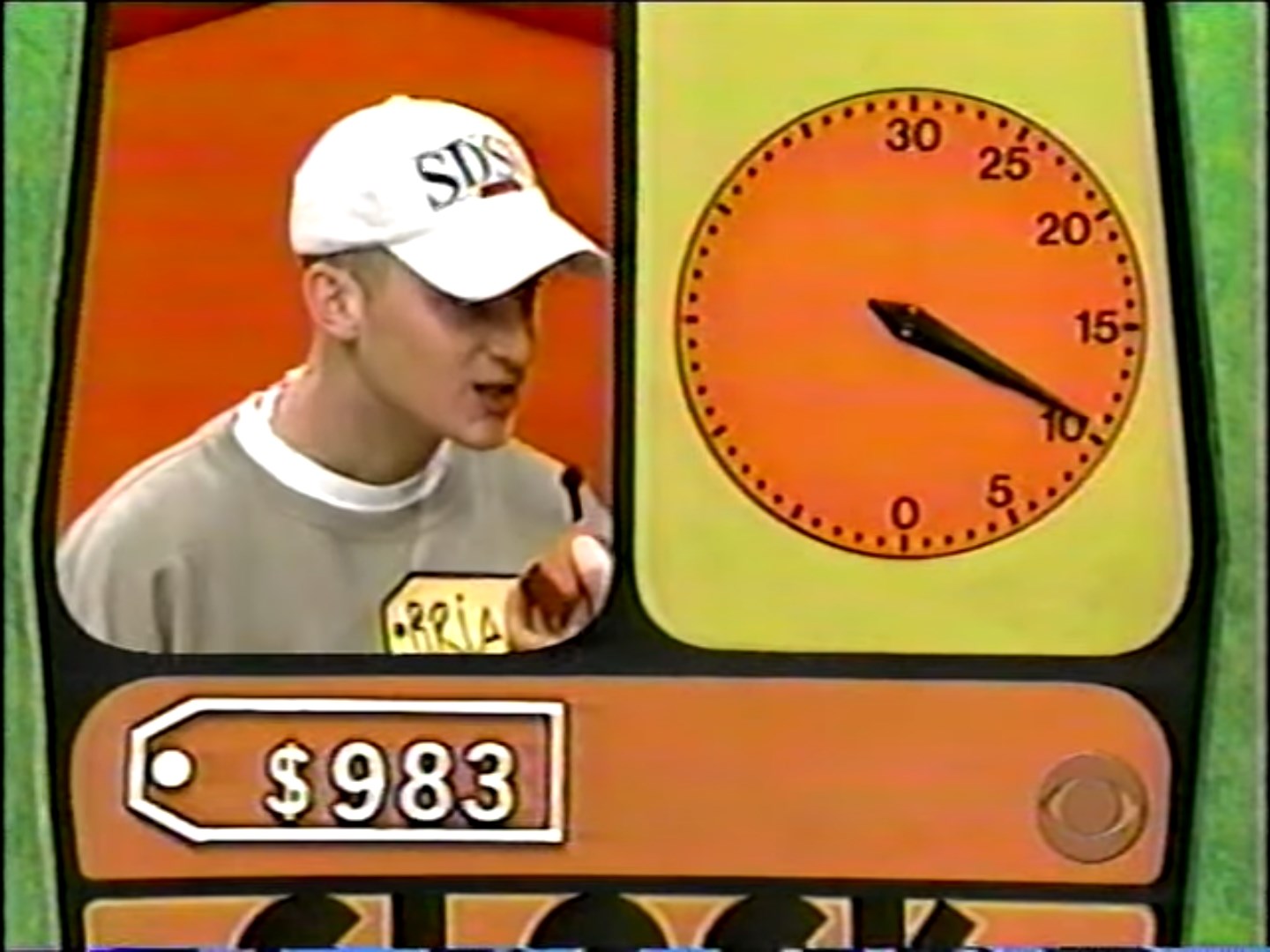
Unlike Bullseye, this basic shot required three of the four cameras: one to shoot the board head on, one to shoot an iso of the contestant that’s superimposed over the game board, and one to shoot the price. The fourth was tied up shooting the prize so the director would have something to cut into the window.

This is why prior to the year 2000, once somebody hit the price, the contestant's image in the window remained where it was once the director cut away from the board to taking the player iso in full--there were no other cameras available to shoot a two-shot of the contestant and Bob. It was a very resource intensive setup but it worked for decades.
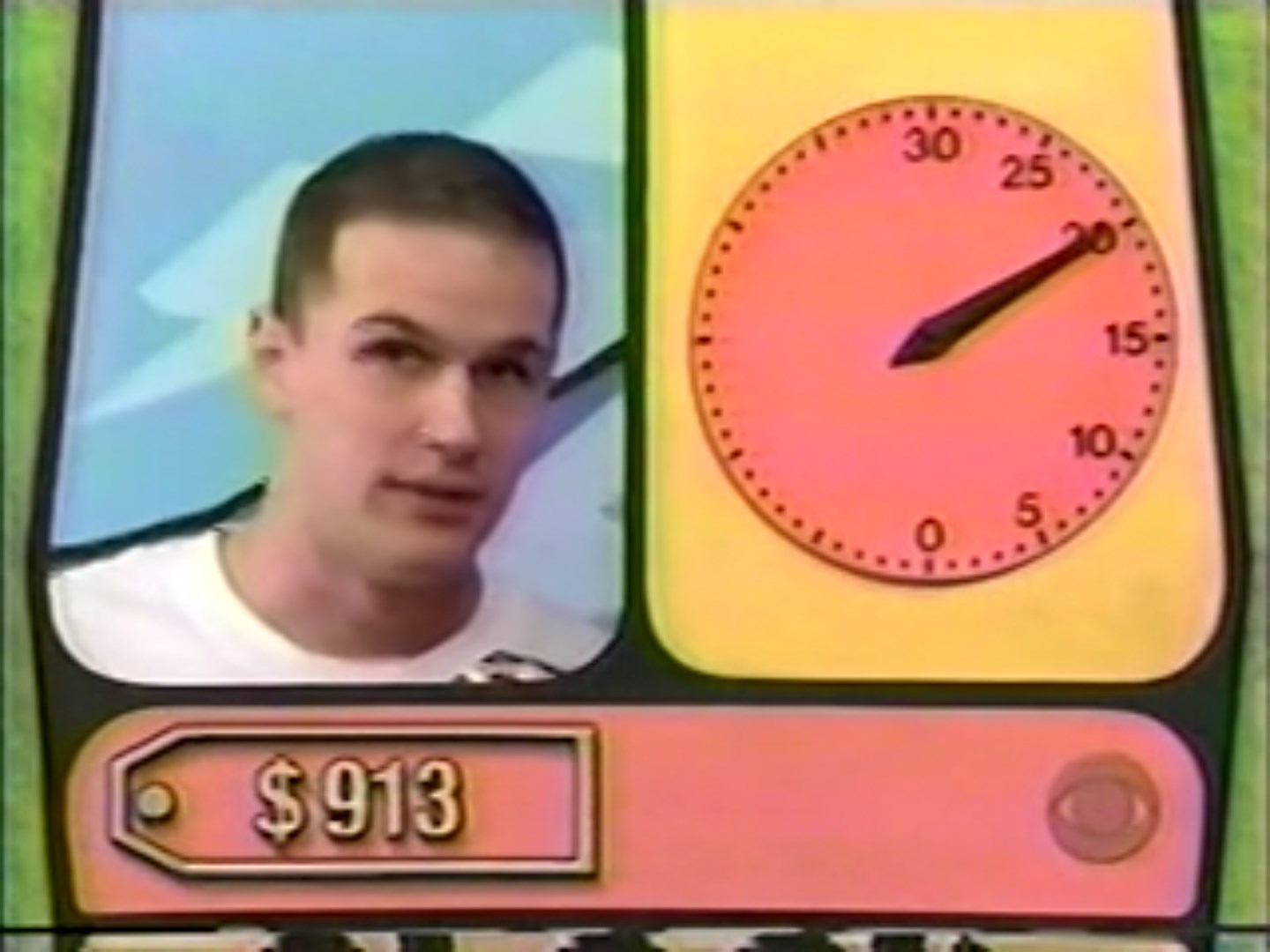
At some point in the year 2000 TPIR gets a new graphics machine. It can generate fonts and superimpose them on the shot via computer. This is better for the director because the third camera that previously was used to shoot the ARP is now freed up to find more interesting shots.
But the set design of the Clock Game board was the same, so there was no reason to change the basic shot composition. There may have been one or two instances of rowdy college kids yelling out the price, but overall the audience was pretty trustworthy.
After 40+ years of service and “the oldest mechanical controls on TPIR”, the old Clock Game set was retired in 2014. We don’t use chromakey to superimpose anymore so there’s no reason to retain the old shot composition. The ARP is revealed with a small graphic now. Like the 2000s, it’s done via a graphics generator in the control room. The new shot looks fine on TV.

Just one problem. It doesn’t look fine in studio. The new graphic is too small to be seen on a monitor by 300 people 40 feet away.

Audiences are squinting to see it on the monitors. Maybe they’re muttering to each other, “is that $866?” and their friend says “no I think it’s $899” and somebody else elbows them with “hey shut up”.
All of a sudden it’s a liability to have the audience seeing the graphic.
Unlike in 1972, modern switchers have no trouble sending one feed to one source and another feed to another source. Blacking out the audience monitors is easily doable with the touch of a button. While they could reveal the ARP to the crowd via cue card… maybe they’ve reasoned letting the audience know the price doesn’t actively make the game better for the viewer, so they cut it.
That’s why my little conspiracy theory has more to do with the new design of the set than it does with audiences being disobedient or the switch from TVC to Haven.
Knowing a taping report from Clock Game at TVC would help point to whether this theory is plausible or wildly off base.